On Pain and Priorities: A Conversation with Jocelyn Jane Cox
Motion Dazzle: A Memoir of Motherhood, Loss, and Skating on Thin Ice
by Jocelyn Jane Cox
Vine Leaves Press, 2025; 270 pp; $17.99
Buy Book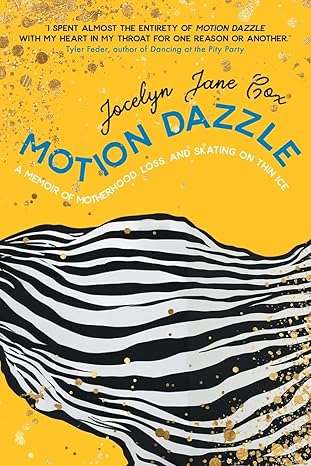
When my friend Jocelyn Jane Cox emailed me an early draft of Motion Dazzle: A Memoir of Motherhood, Loss, and Skating on Thin Ice, I sped through half the book before I remembered I was supposed to be marking it up and sending her feedback. It was that good.
One of the book’s dual timelines, which begins in the past and eventually converges with the present, unspools her mother’s devastating health decline and dementia diagnosis. Having met Cox as an adult, I relished the chance to relive her childhood with her, to watch her as a teen competitive skater swiveling across the ice, to meet her husband, and to admire her fascinating, singular mother in this record of their years together.
The second, present timeline takes place across a single day as Jocelyn is preparing a zebra-themed first birthday party for her son while her mother is hours away in the hospital. As I read, I was struck by how I knew Jocelyn already during this “present” day. And yet, there was so much I didn’t know. What a gift to know it now, and to have this conversation with Jocelyn about her book.
Motion Dazzle is Jocelyn’s first memoir, but she has a long and winding writing career behind her. After earning her MFA from Sarah Lawrence College, Jocelyn started in fiction before gravitating toward nonfiction. Her creative nonfiction, personal essays, and humor have been published widely in outlets like The Offing, Newsweek, and Slate. I was interested to hear more about how this book came to be, and I’m grateful Jocelyn answered my questions with her trademark wisdom and humor. This interview has been edited for content and clarity.
Nicole Haroutunian: Often, memoirists worry about their relatives’ reactions to their book. In your case, you were explicitly writing for your son; the present-day sections are addressed directly to him. When I read an early version of your book, the “you” appeared in both the present-day sections and throughout the past sections. What was behind your decision to change that?
Jocelyn Jane Cox: Pretending this was a letter to my son was an emotional necessity. It was the only way I could approach this project, given that I had written another memoir about 20 years earlier and spent about eight years both revising it and trying to get it published. When my agent was ultimately unable to get it placed with a publisher, I was bereft. While I didn’t quit writing, my confidence was decimated. I didn’t want to have anything to do with the so-called gatekeepers of the publishing industry because I didn’t think I could handle it.
I conceived of this project, originally, as a way for my son to get to know the grandmother he had met only six times before she died on his first birthday. Eventually, around the time I shared a draft with you, I realized that, yes, I did want to try to get this book into the world even if it meant approaching the gates again. By then, I could see the directed “you” wasn’t a sustainable construct for an entire book, so I pared it back. My hope was that this technique would create intimacy, bringing the reader into my head and the specific way I relate to my son. But I suspected that if it was overused, it might actually have the opposite effect, instead creating distance and making the reader feel excluded or outside of our story. So, I decided to use the directed “you” only in the sections about the day of the party, which kick off every chapter, then flow into the end.
NH: Generally, I don’t think it’s appropriate to ask mothers how their children receive their work. It is that old truth that no one asks fathers those questions. But again, your son is your stated audience, so I think it is fair to ask?
JJC: Our son is 12, and he has not read the book. As of this interview, he has read the dedication (to him), the back cover, and the blurbs. He has also read the first page. When he finished that, he said to me, “Wow, you are a really good writer,” which of course made my heart explode. He also didn’t seem compelled in any way whatsoever to keep reading onto the second page, and I am fine with that. I always imagined it as something he’d read when he was “older,” an amorphous time somewhere between 15 and 40. I’d love for him to read it when he wants to and no sooner. In general, I’m trying not to make too much of this publication in his presence. He understands that it’s a big deal for me, but in reality, it’s a gigantic deal.
NH: As a writer, you show your work. You’ll write something once, amend it, amend it, amend it, until it is the clearest, or the truest. Here is an example: “This was the first layer of a proper ‘tablescape,’ her terminology. No, our terminology. No, someone’s terminology we’d adopted.” It’s fascinating to see these little evolutions. Is this a device you were conscious of using?
JJC: Yes, this was a conscious choice. I’m interested in how memories can fluctuate and how the “truth” (very much in quotes) can change—over the years, from one day to the next, and even from sentence to sentence. What I love about reading memoirs and composing this one is the idea of holding many truths at once, not in a James Frey kind of way, but perhaps more in the Rashomon way. There can be different, yet valid, versions of the truth even within one person.
Through revision, a writer iterates. But I think we can do this more overtly in first drafts (and final drafts) as well. I certainly do this when speaking, so I brought it to the page. I am not someone who speaks or thinks in absolutes. I don’t pretend to know all the answers or even all the right questions! It turns out that life is not black and white; it’s not either/or. So much of what I share in this book is about my own doubts, the gray areas, and the indecisions involved in each stage of my life. I experienced a lot of confusion in my skating career, during my years of dating, and in the chaotic time when I cared for my mother. When I see other writers in a state of pondering or revising themselves on the page, it feels genuine.
NH: Can you discuss the tone of your book? I found zero disconnect or distance between the “you” I know as my friend and the “you” on the page. I don’t mean the content so much as how you captured your speech patterns, your humor, and your personality. How did you pull this off?
JJC: In the years before, during, and after I got my MFA in fiction, I played with voice quite a bit in an effort not to sound like myself. This was not only exhilarating in my twenties, but I think it was a valuable exploration. In a roundabout way, when I eventually started focusing on nonfiction, this helped me recognize my genuine voice when I started to use it. By that point, it felt like a relief, and I kind of luxuriated in it. Like, yes, I’m going to use way too many parentheses, I’m going to double back on myself as referenced above, and I’m going to give myself permission to be verbally playful. The first personal essay I ever had published was a somewhat snarky, sour-grapes piece for Slate in 2010 called “Cold Reality: I Never Made it to the Olympics As A Figure Skater, Yes I’m A Little Bitter.” I had been writing a figure skating blog and lots of humor pieces before this, but I think this is the moment when I not only became comfortable with my voice, but also my subject matter. In this case, it was my ambivalence around the sport that shaped my life.
NH: I imagine people will feel like they know you after they read this book. It is intimate, vulnerable, and generous. You’re already quite sought after as a teacher and advice-giver; I’ve witnessed how people flock to you, flagging you down on the street or at the farmers’ market. Have you found that people want to tell you their stories about dementia or caring for their parents?
JJC: I think that being a figure skating coach for 25 years morphed me into someone who readily gives advice. As I mentioned earlier, I’m not the most definitive person, but I’m happy to share my experiences and what I’ve learned so far, to make suggestions, and to throw out ideas. This is the case whether a fellow author is asking for writing feedback or a friend is asking me to help them decide how to use their one free hour that day. (By the way: always opt for a nap.) This leads to some advice I might suggest for caregivers of all types: try to find moments of rest amid the mayhem and don’t feel guilty about it.
The first time I read aloud from the book, I chose an intense section that really went into the depths of my mother’s dementia. I cried. People in the audience cried. Event attendees came up to me afterwards to share their caregiving experiences, and we cried again. This was powerful, and I understood that I’d created space for people to feel those emotions. But I’m also a humorist and therefore more accustomed to making people laugh, so it was a disorienting experience. I’ve decided, since then, to choose excerpts for readings that are a bit lighter.
The emotional texts, emails, and reviews I’ve received from readers have taken my breath away and have also brought tears, but they have been easier to process than in-person reactions. In theory, I have a lot of distance from the events in the book—now 11 years—but I’m continually surprised by the emotions that gurgle up.
NH: You recount, in horrifying detail, being dropped on your head by your figure skating partner. You then share how you blamed your mother for your injuries, your anxiety around starting college, and basically everything that had ever gone wrong in your life. My eight-year-old suffered a disappointment recently that had nothing to do with me, but she was furious with me. She said, “I’m mad at the world, so I’m mad at Mama.” Mothers can control so much of their children’s lives that it is hard—for everyone—to parse where that control begins and ends. Can you talk about this aspect of both your relationship with your mother and your own mothering?
JJC: I am naturally a fearful person, a full-on fraidy cat. Figure skating, in some ways, made me even more anxious, given all the injuries I had weathered, including that final one. I think I learned too much about pain at an early age and from an activity so completely optional, a pursuit—figure skating—that is glaringly privileged. Conversely, as a result of an unspeakably painful childhood, my mother seemed to develop a high pain tolerance. So, as kind and empathetic as she was, it seemed difficult for her to believe me when I shared with her any unseen pain I experienced due to the sport. An X-ray? Or a line of stitches? For me, these were almost better than other injuries because they served as evidence, as proof.
This is a way in which I continue to be opposite from my mother. I cringed when my son fell incessantly while learning to walk. Now, watching him on the soccer field, I’m constantly wincing and worrying about him getting hurt. There is so much in this life that can cause harm; I’m not sure that we need to create resilience, manufacture strength, or require our kids to “toughen up” through sport. Of course, there are many positive benefits kids can gain from athletic participation, but I’m not comfortable with the risk of injury. I never became inured to this as a coach, and I probably never will as a parent either. This said, I’m also not going to forbid my son from playing sports or layer him in bubble wrap. I’ve learned that the body does heal. Or, it does to a degree, anyway . . . probably better than our psyches.
NH: I found it arresting that, at the very start of the book, you write that you loved your mother as much as your son. I’m not sure if I’ve ever heard someone admit that before. What a hard space to be in, when they both needed you so much—I mean, that’s what the book is about! Near the end of the book, you write: “I needed to be a mother that day, just a mother, nothing else.” Can you talk about this push and pull?
JJC: Yes, it could easily be argued, and is hopefully easy to see in the pages of Motion Dazzle, that my mother gave everything she had to my brother and me. I knew this from a young age, and not because she ever called it out or underscored it for us. It’s just who she was and how she was. So, when she was hurting and losing her independence, did that mean I should give everything back to her as a form of reciprocity? Or should I take on her motherly example and pass it forward by giving everything I had to my son? It was not a decision I could make, so I flitted back and forth for those years, giving as much time and attention as I possibly could to both of them, running myself ragged.
On the day of that first birthday party, I was determined to prioritize my son even though my mother was in the hospital, a place she had to visit often in her later years—therefore hospitalization had started to take on less dramatic weight. But on that day, I was also prioritizing myself. Not everyone wants to throw a DIY party like I did, and I realize this is a form of additional maternal labor that I opted in to. But making a cake from scratch, typing up a ridiculous trivia sheet, and tablescaping with vigor brought me so much joy, something I was in desperate need of at that time. And you know who taught me how to throw a party in that fashion and whose tradition I was absolutely continuing? My mother’s. I was separated from her on that fateful day. But she was also somehow with us, there, in every last detail. I trust that she would have wanted me to be doing exactly what I was doing on that day.