
Masks of Perfection: A Review of What’s Yours Is Mine
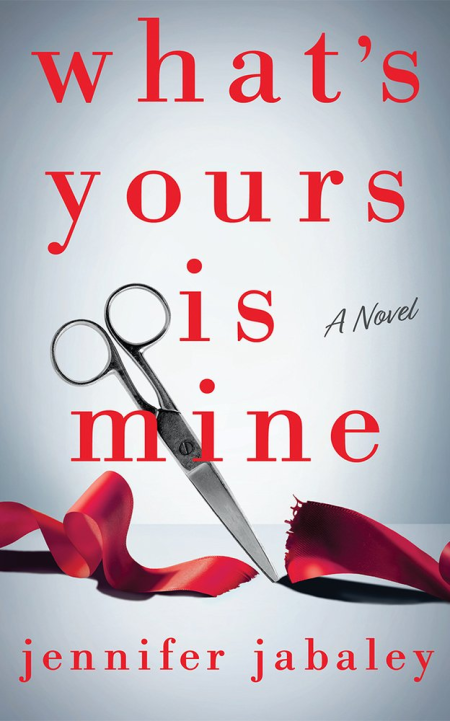
Jennifer Jabaley has a knack for creating flawed characters, exploring their fault lines, and driving them all to the edge of ruin. At least, that’s what she’s done within the plot of her latest suspense novel, What’s Yours Is Mine. The story revolves around the entangled lives of 15-year-old best friends, Kate and Colette, and their mothers. The girls are rising dance stars who become rivals when their talent launches them into an elite dance competition with only one winner. But the girls’ rivalry is nothing compared to the one between their mothers. Valerie, single mom to Kate, and Elise, queen-bee-dance mom to Colette, go from admiring each other’s commitment to their daughters to jealous suspicion and accusation within a few chapters. Their trajectory reminds me of the 1991 murder-for-hire crime committed by a Texas cheerleader’s mom who wanted to eliminate her daughter’s cheer rival. Their desire for their daughters to succeed propels them from involved, supportive mothers to unhinged, enmeshed adversaries.
The story is told through alternating perspectives of all four characters. In early moments, each mother’s point of view feels achingly familiar. Valerie, the single mom, feels “a never-ending simmering pot of guilt” because she can’t seem to connect with her daughter as “the teenage years barreled through their home like a bad storm, transforming her once sweet, loving child into something unrecognizable.” Elise, a former prima ballerina, wants to give her daughter the attention and opportunities that Elise did not receive as a girl. It seems natural that these mothers want to connect with their children and give them every opportunity possible. But Jabaley twists her characters beyond the recognizable with secrets and lies, regardless of the consequences for their families.
Elise, a character with singular focus, seems to unravel first. When her husband accuses her of “spending too much time, too much money, too much brainpower on dance” and completely ignoring their son, Elise overreacts: “Her breath caught; her lungs squeezed as if she’d taken a blow to the back. She felt blindsided. Her emotions barreled past anger and slid down to despair. Once, she’d been the brightest light in the room.” Now, she is criticized for helping Colette prepare for the dance competition.
Elise continues to plot Colette’s path: They must eliminate the opposition, including Kate, who she once considered like a daughter. She believes Kate will ruin Colette’s chance to win. She claims her devotion is solely for the benefit of Colette, but her rage, panic, and fixation on Kate suggest something more sinister.
Through Colette’s perspective, we see Elise’s callousness and obsession. When the two travel to competition headquarters, Elise says, “There’s no telling how far you can go. How high you can soar . . . as long as you don’t let anyone get in the way.” When they enter the elevator, Colette watches Elise’s public façade melt: “The mirrored doors slid closed, the light darkened, and Mom’s reflection suddenly morphed, dimming her joy. Shadows cut angles into the sides of her cheeks. Her smile faded into an expression of sternness, like a fairy godmother ripping off her mask.” The effect is chilling—Colette is alone with her mother, but instead of feeling a reassuring presence, she feels Elise’s hyper-competitive and threatening edge. This inflection point in the story causes deep angst for Colette who wants to believe that her mother has her best interests at heart. But that would mean that her best friend is now a rival. Colette questions her own instincts, doubts her own ability, and withdraws from friends and family.
Jabaley makes readers wonder if Elise could be right about Kate when Elise recalls her own “brutal memories of the professional dance world. . . . How every bloodthirsty ballerina would stop at nothing to reign supreme. . . . All the drama and secrets from her years in New York bubbled to the surface.” Through internal dialogue and conversation with family, Elise retells her story, changing the details with each version, and remains frustratingly “secretive about her time as a professional ballerina.” It’s not clear whether Elise’s attempt to control her daughter’s fate is self-sacrificing or self-serving. Jabaley’s ability to complicate her characters with sympathetic backstories provides nuance to characters who would otherwise be pure villains.
Valerie, a seemingly sensible, loving mother to Kate, allows her own insecurities as a parent to spiral into a trail of deceit. Her ex-husband disappeared years earlier and “when Kate started asking where he’d gone . . . all these pristine dance moms with their expensive cars and catalog-perfect families inquired [and] . . . it just seemed easier . . . to be a victim of a tragic accident [and] . . . lie.” When her ex-husband reappears more than a decade later, Valerie is forced to tell 15-year-old Kate the truth. Valerie continues to betray Kate’s trust. She reads her diary because “lately, a crippling fear . . . gripped Valerie that Kate, fueled by teenage drama, would emancipate herself and go live with [Elise].” Valerie chooses to protect her own feelings rather than put Kate’s needs first. Each character in this dark tale twists the facts to fit their own narrative and they believe their own lies are reasonable, necessary inventions to protect their reputations.
The dance mothers spend their days trying to “help” their daughters, but spend their evenings criticizing the children from the dance studio’s observation room. Elise notices a girl’s “clumsiness, like her limbs were made of tin cans.” Another mother says, “Well it’s not like her knuckles are dragging on the ground.” The girl’s mother says, “Oh my God, like a gorilla?” The women carry on, eventually taking their judgment to their Pilates studio where they criticize each other behind their backs: their clothing choices, their hormone levels, and their need for plastic surgery. It’s as if they are middle schoolers vying for the role of popular girl, rather than adults who should be role models for their daughters. The swift unraveling of mothers, daughters, friends, and family is soap opera entertainment at its dramatic best. But beneath the suspenseful plot, Jabaley addresses the real dangers of competitive, performative relationships.
The teenagers in the story mimic their parents’ behaviors as they navigate social and academic pressure at school, inside the dance studio, and online. Colette is committed to keeping every negative feeling and worry inside, “letting the world see only a mask of perfection.” Meanwhile, Kate struggles to keep her composure after a fellow dancer falls and the girls are instructed to “ignore any interruptions.” She feels forced to leave her injured friend on the stage floor.
Even when the girls leave the stage, they are unable to stop performing. A dance coach instructs Colette to create “intriguing [social media] content to formulate a certain aesthetic.” The constant fantasy-making and blurring of truth leaves the girls with no room to relax. Even at their homes, and with their families, they can’t find a safe place. Valerie invades Kate’s privacy by reading her diary, and Elise encourages Colette to keep recording content, even after Colette receives cruel and cryptic messages from her followers. The mothers have captured their daughters in a complex social web with no way out. Jabaley nails the dark edges of competitive parenting. When the adults lose their common sense, the kids are left to manage their own safety and well-being, around fellow dancers, online commenters, and even their own mothers.
Jabaley’s book is so gripping because Valerie and Elise initially seem to be loving mothers who want to help their daughters. These mothers could be any mother. But along the way, they lose sight of their children’s needs. Colette says she wants to “just be happy,” but that is not enough for Elise. The desire to win at competitive parenting takes over. Jabaley exposes moments of parental support and bends them into something devious and feral. The story is a cautionary tale for all the mothers plotting their children’s future from the sidelines.