
God Listens. God Remembers. A Review of Pieces You’ll Never Get Back
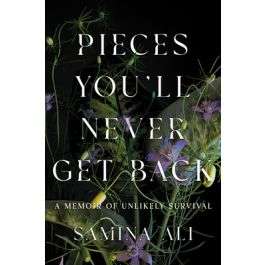
Pieces You’ll Never Get Back: A Memoir of Unlikely Survival
by Samina Ali
Catapult, 2025; 272 pp; $27.00
Buy BookMotherhood, for many new parents, is life-changing. Life-sacrificing. Samina Ali’s transformation and surrender are more literal. And violent. “I hadn’t realized that ushering in his life would require me to give up my own,” Ali writes as she describes the birth of her son in her memoir, Pieces You’ll Never Get Back.
Moments after giving birth, Ali is in a coma with severe brain and body trauma—a result of misdiagnosed and unchecked eclampsia. While Ali is moved into the neuro-ICU, her son, Ishmael, fights his own battle in neonatal intensive care. When Ali wakes, she does so without recollection of giving birth, or any memory of her husband, her friends, and much of her history. Fluent in multiple languages, Ali has large gaps in understanding beyond her native Urdu and no memory of why she was in the hospital. The loss seems exhaustive.
Ali’s story begins with “Death”—the title of the memoir’s first section.
In “Death,” we follow Ali through the peril of this birth, fueled by dismissive doctors who refuse to listen to Ali’s multiple assertions that she is in pain—unusual pain—and that something is not right. Ali is given an epidural she doesn’t want, and Alka-Seltzer to treat chest pains when she is actually having a heart attack. The trauma of this scene, which climaxes in a grand mal seizure, was likely avoidable. For weeks, Ali and her husband had expressed worry to her physicians that her pregnancy, body, and baby were in danger.
Waking from her coma, Ali is in pieces. Memories are lost—some forever. She’s unable to talk; her gross and fine motor skills are diminished. The neurologists describe her brain as a set of puzzle pieces waiting to be assembled or “islands of neurons within each hemisphere working independently.” Ali’s job is to put those pieces back together.
“Death” itself seems to be pieces of a puzzle, both to Ali and the reader. This section is often written in vignettes; short descriptive chapters that repeat thoughts, actions, and even exact phrases. This writing style is incredibly effective: at times chaotic, at times adrift. Chapters jump back and forth in time and scene, trying to rebuild the lost narrative that parallels Ali’s disjointed memories and trauma.
The author reflects on the irony of writing a memoir that is filled with memories that are not her own. While Ali eventually regains her memories (these come back to Ali in a flood, rather than a gentle flow, in a scene which is so overwhelming I had to pause mid-read and catch my breath)—there are entire windows of time that are lost forever. Instead, they are borrowed from her husband, her parents, brothers, friends, and the collection of medical records that clinically and coldly outline her injuries. Ali even questions the accuracy of her recovered memories: “. . . it’s all there, in the fragmented memories I’ve been able to recover, moments unconnected to others, neurons floating in isolation on islands—but doesn’t that alone, the fact that these are recovered memories, make them suspect?”
The need to rebuild her memory and her physical body is an unintentional invitation for a reset, a repair, a rebirth: like her newborn, Ali becomes infantile as her brain and body work to heal. After a shockingly short two weeks in the hospital, mother and baby are at home developing together—their complex web of wiring and neurons working to evolve beyond their bodies’ basic human needs. “The hours of the day no longer determined my schedule, the needs of my body did. Like my son, I woke when I was hungry or when I had to use the toilet. The minute the needs of my body were met, I was out like a light,” Ali writes.
It is agonizing to read the initial disconnect Ali has with her son, even expressing moments of jealousy and anger when having to share attention with Ishmael as she describes competing for care from her mother with her newborn. She writes, “Giving birth doesn’t automatically transform a woman into a caregiver . . . I felt no bond with my son.”
There are many powerful and honest moments such as this in Ali’s memoir, and while they exist in an incredible, singular story, it’s in these moments that I most relate to Ali. I first became a mother at eighteen—a time in life where we’re already in transition, and are often just beginning to understand independence and self-care in the very literal sense. I had no idea what it was to be a mother. I pored over the Mayo Clinic Complete Book of Pregnancy and Baby’s First Year, armed with a highlighter and sticky notes; I figured all the answers I needed were in there somewhere. But the guide from the Mayo Clinic didn’t teach me how to love someone I had never met. The act of giving birth didn’t do that either.
In Ali’s case, this kind of love is even harder to define in a brain that has no reference point or context, even though examples from her parents, siblings, friends, and husband surround her. The puzzle pieces aren’t ready to fit. While there are huge moments of celebration throughout Ali’s healing, nowhere else does the author write with the same energy and joy as when her undeniable desire to protect and nurture her son finally appears. A minor car accident involving Ali and her son activates a change in the author. Ali writes, “Ishmael began crying, startled by all the noise and jostling. I sensed his fear. Instantly, some protective instinct in me was aroused. I’d let nothing harm my son!” She continues, “All I could think was that my maternal instincts had finally been born! At the sounds of my son’s crying, I’d done exactly what I needed in order to protect him.” This moment is a transformative piece that begins to reshape the puzzle of Ali’s parenthood. Here too, I can relate.
Woven throughout Ali’s story are her spiritual journey and religious history. Arguably, there are few times in life more connected to a spiritual plane than when we give birth or face the end of life. Ali’s Islamic faith was central to her understanding of her place in the world until her injuries took that from her too. But she still believed in miracles, even though miracles take work in Ali’s story. And they take writing.
Ultimately, Ali credits writing with her healing. She writes, “I’d always believed that writing was sacred. The pen and the book were signs, ayah, miracles.” Writing is one of the first instinctual actions she takes once memory and motor skills start to return. Initially, she writes words and sentences that are gibberish. Plot and characters are impossible. Her mind fights her—it is painful and draining to even sit with words for a handful of minutes. The thought of losing her ability to write was like “God withdrawing from my life.” She fights for it; for Ali, it is the only way to treat the trauma she is experiencing not only to her brain and body, but to her very spirit.
As Ali notes in her dedication, bookending Pieces You’ll Never Get Back in the prologue and epilogue are Ali’s children: Ishmael and a daughter, Zaara, born years later. Here we learn the complex narrative of these names in history, in varying religious stories and cultures across our world. These are more than just names to Ali; they are words. And to a woman who attributes not only her healing, but her identity, to words, the significance and thoughtfulness that went into these names does not go unnoticed. They are precious words in a world of precious words. Ali tells us that Ishmael means “God Listens” while her daughter Zaara’s name means “God Remembers.”
Listening and memory are powerful cornerstones of Pieces You’ll Never Get Back. Ali’s story begins with the deafened and dismissive ears of doctors, whose inaction welcomed death into birth. But the memory of the words that strengthen her and the love that she finds for her children teach readers that it is not the end. It’s, in fact, the start of new life.