
Complicated Grief: A Review of A Living Remedy
When I told a friend of mine I was heading out to see Nicole Chung read at Powell’s from her book A Living Remedy, she told me she’d just finished reading it—and that it was incredible, but devastating. This friend and I prepare little content warnings for each other when topics arise that impact not only a wider audience, but more specifically, mirror our own unique traumas. I warn her about cancer plot twists; she lets me know if there’s a dead mom lurking somewhere. That time of year, early April, is usually when I avoid any content about moms—dead or living—because it’s the anniversary of the worst days of my life, when my mother passed away after a seven-year struggle with breast cancer. But then my friend’s next text came through: It’s worth it, though.
I decided to take the plunge after hearing Chung read that night, convinced by her calm, comforting, discerning energy and the excerpts she chose to read. In the first chapter, we learn intimate details about her close but fraught relationship with her mother as a Korean adoptee, and how much she wishes she were still alive. When Chung read a list, one of several included in the book, entitled simply, “Things My Mother Sent Me After I Left Home,” I could immediately tell: although this book about grieving, parenting, and creating during the tumultuous days of 2020 wouldn’t end in a silver lining, and it was definitely going to make me cry, it would indeed be worth it.
Once I started reading A Living Remedy, I couldn’t put it down. I read while nursing my son in the mornings and brought it with me to daycare pickup in the afternoons. I underlined and dog-eared and wrote notes in the margins like, “Yes!!!!” and “Ugh. Gut-wrenching. So unfair.” Chung expertly captures the mundane minutiae that make up relationships—leaning against the doorframe and recapping her day while her mother lies in bed, or the drives she took with her father through misty Oregon hills. Reading Chung’s story of the lead-up to and the aftermath of her mother’s death made me feel the same way I felt reading Joan Didion’s A Year of Magical Thinking or Carmen Maria Machado’s In the Dream House: seen, held, definitely not crazy, definitely not alone.
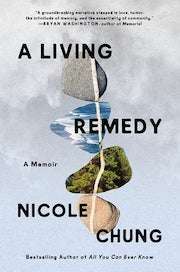
From the very first chapters, we know what’s coming: her parents are going to die, and it’s going to be absolutely heartbreaking. Chung does an exquisite job of choosing the perfect details to shape her parents into real, complex characters. They aren’t perfect parents, but it’s clear they loved Chung deeply, in both the universal way that all parents love their children and in the unique ways that adoptive parents do. Early on, we feel the tension that Chung experienced growing up—the responsibility she feels for her parents as an only child is in contrast to her desire to explore as an individual, the tension between the depth of her parents’ love and the pressure of being “chosen” as an adoptee, the need to prove herself worthy. Her parents’ life is one of precarity, and they never ask Chung for help despite confronting complicated, prolonged illnesses with no health insurance or financial safety net; still, the guilt she experiences as she pursues a dream career on the other side of the country and raises her own family is one that is deeply familiar and relatable.
Chung writes with a raw intimacy, and she is especially vulnerable and brutally honest about the despair she faced after her mother died, in those dark days of her early grief, which coincided with the COVID-19 pandemic. “Loss in this time of distancing and isolation can feel like skirting the borders of a deep, dense forest that is still largely unknown and unexplored,” she says. “If it hurts this much now, at the outermost edge of the woods, I wonder what will happen if I am ever able to venture in.” Grief can be transformative, sure—eventually—but Chung ensures we understand that there’s more to this picture, and that this painful story is bolstered by the lack of space and support our culture gives us to grieve. Friends, family, even Chung’s husband, make efforts to help her manage, but work continues, bills come due, and she has to find ways to make her own space.
At its core, this book is about mothers—both the writer’s mother and herself—trying to solve problems that are either fundamentally unsolvable (like the pain of grief) or only unsolvable because our system and society make it that way (like the medical-industrial complex). Chung’s mother had to navigate her cancer treatment (and her late husband’s acute illness) without a financial safety net, while seeing the concrete effects of putting off necessary healthcare. Chung herself had to balance supporting her parents and being there for her own daughters, a painfully perfect example of the ways that being part of the sandwich generation impact moms, particularly in the early days of the pandemic. After her father dies, Chung says, “I didn’t want to have to be a parent while I buried my father; I only wanted to be a grieving daughter.” Chung and her mother both struggle under the pressure and responsibility that our society places on moms to solve these problems, knowing that this is unfair, but unable to do anything else but try. I felt a familiar clutch at my chest after Chung describes the “constant, low-level panic attack” she was experiencing, and then details, “even then, I kept working, taking care of my children, doing what needed to be done.”
By the end of the book, Chung finds the answers she had so needed: that her mother felt she was enough. Chung doesn’t quite yet believe this, but some of the darkness has cleared, and she knows she will be okay someday, “because,” she says, “my parents love me, and to live is to remember them.” In a different book, by a different writer, this might have been the last line—cue “the transformative power of love and grief”—but, as usual, Chung reminds us of the pain and regret she will always carry. She ends the book in the past, months before her mother dies, her arm around her daughter, waiting for her mother to wake. It’s optimistic, heartbreaking, profound, painful, and, like the rest of the book, so, so real.
It’s worth it, though. It’s worth it to love your parents as deeply and fiercely as Chung did, it’s worth it to pursue a motherhood that allows you to fulfill your needs and those of your family, it’s worth it to be honest with yourself about your darkest thoughts and feelings. And it’s definitely worth it to read A Living Remedy.