For When Your Hoof Is Caught in the Quicksand of Late Capitalism: A Review of We Are Animals
We Are Animals: On the Nature and Politics of Motherhood
by Jennifer Case
Trinity University Press, 2024: pp. 216, $19.95
Buy BookThere are moments, reading Jennifer Case’s collection of essays, We Are Animals, when I can feel something twisting in my belly, a sharp discomfort in my deepest recesses. Case writes about the interior intricacies of her experience as a birthing person in the post-Roe era, including her planned first pregnancy and her “unintended” second pregnancy.
Like me, Case suffered from PMAD: perinatal mood and anxiety disorder, a constellation of conditions that can present during pregnancy and the postpartum period. No two PMAD cases look the same, with symptoms that range from catatonic depression to extreme anxiety and intrusive thoughts. Case’s took on a different form and timeline than my own, but the commonality is that we both ended up sad and diminished, holding on to babies we weren’t sure how to care for. “I schedule ob-gyn appointments and take prenatal vitamins, but after I drop my daughter off at preschool, I also willfully imagine myself getting hit by a truck,” she writes. This bleakness, and the cozy normalcy with which it presents, I know.
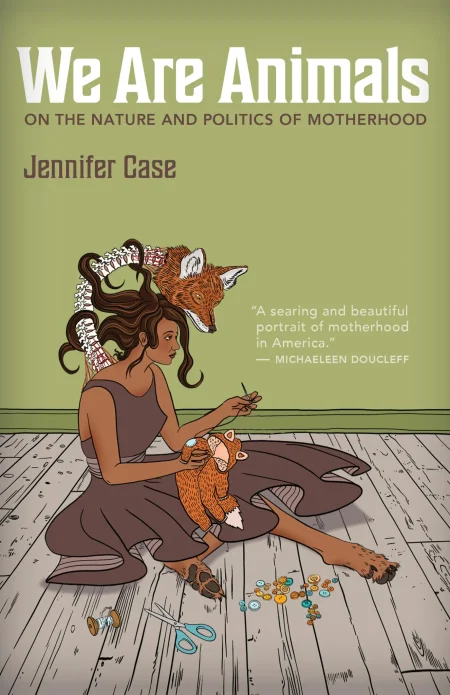
The cover of Case’s book is an illustration depicting a hybrid creature: the torso, limbs, and head of a human woman with the feet of a fox, and a fox’s spine and head growing out of the woman’s own spine. We are animals, the title reminds us, as the fox-woman mends a tiny fox suit with a sewing needle. I take this title as an insistence, perhaps even a minor rebuke—a splash of cold water in the face to remind me that many of the struggles I have experienced and continue to experience as a parent are not really personal failings. They are the failings of an animal trying to perform labor in a manner that is defined not by my own instincts or by any cultural wisdom but, rather, in a manner that allows me and my child to exist in the cramped negative space left behind by the structural demands of societal institutions. Government and employer come first, and we can have what’s left, as a treat. When I remember this, I feel two contradictory things at once: a rare and pure relief that I am not uniquely bad, that I have not failed in an idiosyncratic way; and rage that I, a fox mother, am being asked to do things like file quarterly taxes and attend trainings wherein I learn how I might evade or disarm a school shooter. Excuse me, but I am an animal. I am meant to be leaking milk and blood, I am meant to take shelter with my small cub. I am not meant to be applying corrective concealer to the rash I got from crying too much. I am not meant to be googling which adult diaper can collect enough blood to get me through a work day. Speaking as a fox: fuck that.
The subtitle of Case’s book, On the Nature and Politics of Motherhood, as well as the essays “Birth Work in the Bible Belt” and “On Race and Motherhood in America,” squarely situate motherhood as a political event—something that I did not understand until my own baby was several years old and I found myself groping for meaning on the other side of my own harrowing PMAD, radicalized by the act of becoming a parent in a political and social environment that is actively hostile to parenthood. Much of Case’s work in her collected essays is an argument for the interconnectedness of our lives as political subjects, our labor under capitalism, and our existence as gestational animals—as mothers. She makes a strong case for the ways our treatment in the civic and political sphere informs the domestic: The demands on our time, our labor, and our political identities are not separate from our lives as milkmakers and napgivers.
Case writes with tremendous honesty about her unplanned, undesired second pregnancy and the work she did to arrive at a place of love and gratitude for her child. “The early months of my son’s life are like whiplash, a sometimes daily wrenching between health and despair. . . . Sometimes a darkness overtakes me, quiet and quick. I know that in having him I have made a terrible mistake.” Case knew she wanted an abortion but felt sure that her marriage wouldn’t survive it, so she kept her unplanned pregnancy. Her book is a complicated treatment of regret and conciliation, and she refuses to reduce it for our comfort. She didn’t want the baby, and she felt trapped into having it anyway, and she loves the baby and is grateful for him. All these truths, at once. “We sit on the couch, three and a half years of the Trump administration ahead of us. . . . My bra smells of breastmilk. My son, who we both love, cries in the bedroom. Like the country around us, we are cutting new teeth.”
When I say that the US is actively hostile to parenthood, what I mean is that if Jennifer Case had opted for an abortion, she would have had to travel away from her home state and her small child. I mean that we are the only developed country without federal parental leave. I mean that the US is the most dangerous developed country to give birth in, and multiply that if you’re a parent of color. I mean that Case and I have both experienced, firsthand, the impossibility of working and parenting at the same time. I mean that from the moment I became pregnant, I found myself acted upon by a long list of institutional protocols and procedures that have done little to protect me and much to interfere with my self-actualization as a parent. What I mean is that my pregnancy was unnecessarily medicalized, my birth was inappropriately intervened upon, I got zero leave from work and had to return to the classroom wearing an adult diaper to collect my uterine blood. I mean that the mental healthcare I have received has been so paltry and insufficient that I no longer pursue it through traditional avenues, and nothing—not the airport, not a restaurant, not a parking lot—is set up for ease of use by a parent with a child. We live in a world where a critical mass of adults believe that babies and children should not be permitted on airplanes, in restaurants, or in spaces of culture. I am not a single parent, but because of the necessity of two incomes in my family, I am often parenting alone during the course of any given day, and I have been pressured to leave readings and clubs because my (silent) child was considered a disruption. None of this makes it tolerable to cheerfully raise a child, and when politicians lament the falling birth rate, I would love to ask them what exactly they are proposing—what plan, exactly, they have in mind to make parenting a small child less of a crucible.
One of the true gifts of Case’s work is this remembering of something that I was never taught in the first place. “In the deep folds of your pelvis . . . you have always known the answer. You have always made the choices you needed to make. You are not stupid. And when the next choice comes you will gather yourself—milk, bones, and bristle—and you will go.” I might enjoy the limited bodily autonomy of an American woman (which is to say, more than a lot get, but not as much as I should have), but that does not mean I am a limited creature. I, like all the rest of the animals, hold something that is increasingly fraught to maintain: a whisper of knowledge of what it means to be free.
4 replies on “For When Your Hoof Is Caught in the Quicksand of Late Capitalism: A Review of We Are Animals ”
Wow, amazing essay on what sounds like a great book. Spot on writing, Margo.
Great review and thought provoking essay.
A great book and an insightful review. Thank you!
Gorgeous and thought provoking writing. Even this non-mom wolf is intrigued.