
Stop the Fuzzy Monkey Model Mom Striving: A Review of Nancy Reddy’s The Good Mother Myth
The Good Mother Myth: Unlearning Our Bad Ideas About How to Be a Good Mom
by Nancy Reddy
St. Martin’s Press, 2025; 256 pp; $28.00
Buy BookIn The Good Mother Myth: Unlearning Our Bad Ideas About How to Be a Good Mom, Nancy Reddy looks back on her sometimes miserable experience as a first-time mom hell-bent on finishing a PhD in English, determined to be all things—a devoted primary parent, graduate student, and worker—while struggling with insufficient childcare and an undiagnosed postpartum mood disorder. Along with her personal narrative, Reddy analyzes parenting norms and their origins, namely the major parenting experts of the twentieth century. The psychologist Harry Harlow particularly haunts Reddy as she recalls how she studied, worked, and hauled her baby around the same University of Wisconsin-Madison campus where Harlow conducted his famous cloth monkey experiments. Besides Harlow, Reddy identifies Benjamin Spock; John Bowlby, a British psychiatrist and psychoanalyst; Donald Woods Winnicott, the United Kingdom’s proto-Spock; Mary Ainsworth, a Canadian-American psychologist; and Margaret Mead as luminaries whose influences still affect how mothers perform parenthood in the United States.
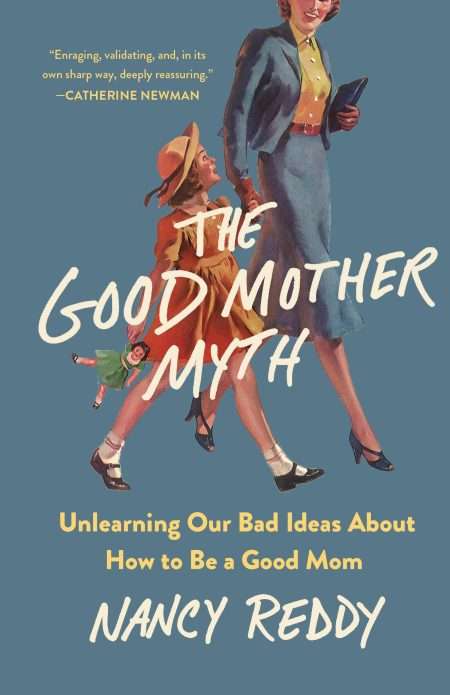
As a voracious reader of both maudlin motherhood memoirs and parenting guides, I deeply appreciated the unique format of The Good Mother Myth. Reddy layers the history of social science research on mothering along with her personal experience like a nonfiction lasagna that I devoured before I even realized how hungry I was for a smart, vulnerable book-length narrative about how and why our culture sets up exacting, impossible expectations for mothers.
Reddy writes delightful send-ups of last century’s social scientists. That cloth monkey study? Turns out, Harlow chose rhesus monkeys out of convenience, not because they were the simians that most closely replicated human babies. Margaret Mead? Sure, she was an empowered, feminist polycule participant who could have changed the lonely, corporatized approach to U.S. parenting, if only she hadn’t pulled the ladder up behind her. Reddy also explores the beleaguered lives of the scientists’ wives who did the actual child-rearing. The Good Mother Myth makes history fun and feels like paging through a dry textbook with a witty classmate who deploys snide-bombs whenever they encounter a patriarchy bunker. Here’s Reddy on John Bowlby: “Let’s pause for a moment here and note how wild it is that Bowlby was charged with studying the well-being of homeless children following a global war—and came back with a report arguing that the primary problem those children faced was inadequate maternal care.” Reddy splashes irreverent cold water onto the patriarchal attitudes that have affected parenting culture since the first attachment theory studies were published. Her playfulness injects some levity into the never-good-enough plight of modern mothers.
Reddy’s memoir sections contain quotidian but compelling stakes. Will she finish her dissertation? Find parking? Connect with mom friends? She’s a basic, ambitious woman following a prescriptive, second-wave feminist path, only to find that she’s been catfished by the supposedly fulfilling working mother destination. In a reflection about whether choosing to have a baby makes her more responsible for childcare than the baby’s father, Reddy writes, “The baby had been my idea. I wasn’t sure I was allowed to ask for help.” Balancing her teaching, writing, and parenting responsibilities requires Reddy to find help with her baby—from a drop-in daycare at her gym, a provincial in-home daycare provider, and a male professor who offers to hold the baby so Reddy can take notes in a dissertation workshop. Reddy, a writing teacher who has published two poetry collections, co-edited a literary collection about motherhood, and writes the popular “Write More, Be Less Careful” newsletter, belongs to a cohort of high-achieving women who have self-policed their maternal desires and wage-earning responsibilities to the point of self-flagellating independence, confusing “have it all” with “do it all.”
Reddy compares herself to other mothers she meets in postnatal exercise classes, mothers in her family, mothers in the media, mothers in social science experiments, animal mothers in captivity, famous mothers like Margaret Mead, and mothers shunted to the domestic sphere like the wives of Bowlby and Harlow. She traces mom guilt back to specific research studies, lamenting how mothers are led to believe that advice will guide them, in place of a radically different social structure—one in which the government could support parents with adequate childcare, healthcare, and education. Harlow removed so many variables from the cages in his experiments that the young rhesus monkey test subjects had no choice but to prefer cloth mothers over wire models holding food, and Reddy looks back at how his flawed studies unintentionally created a harmful legacy and an impossible trap for contemporary mothers. According to Reddy, Harlow’s attachment theory fallacy feeds the Greek chorus of Judgy McJudgersons in public, planted like double agents in families, and amplified online.
Like Reddy, I parented a newborn with a difficult temperament and experienced a persistent, low-grade, doing-it-wrong internal critic, despite how closely I tried to adhere to the parenting how-tos I read in books and on social media. Reddy acknowledges the double-edged burden of new-mother information overload by writing about how parenting resources can be great but also set us up for loneliness and feelings of inadequacy: “We know more than ever about evidence-backed methods for potty-training and which experts can help us learn how to get our kids to eat their vegetables—but each new piece of advice, each new voice telling us how to do it right, seems to only make us more anxious about our kids, and about ourselves.” Reddy’s analysis points out that, instead of a village, our siloed society provides à la carte enrichment activities that keep us mostly connected to parents in our socioeconomic class, with kids the exact same ages as our own, constantly looking over our shoulders to see if our supposed peers are all doing a better job than we are. By writing about her own lonely early motherhood experience, Reddy provides a prime, personal example of why and how the system could change for the better.
Anyone who has tried to juggle a baby with a job, a degree program, or a bag of groceries will relate to this self-aware memoir, from the basement monkeys and the salacious details of yesteryear’s parenting influencers, to the critiques about what makes contemporary motherhood so isolating. Reddy showcases the crummy, postwar singular care system that sets up exacting, impossible expectations for mothers and offers too much ostensibly helpful information, when what most parents really need is a couple of extra sets of hands. Her examination of antiquated norms extrapolated from mid-century animal behavior research that places the onus of caregiving almost entirely on nuclear family units is a refreshing take on parenting history, and a welcome argument for a sustainable system of support that centers the village, not individuals.
Discover more about Nancy Reddy and her book, The Good Mother Myth, on our Podcast, This Mama Is Lit!