An Expatriate on Route 66: A Conversation with Winnie M. Li
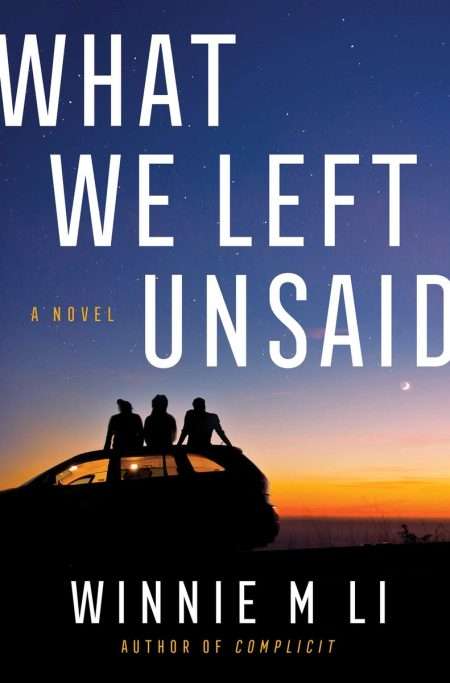
After 25 years abroad, Winnie M. Li finds much about her birthplace in the United States to be unfamiliar. From re-experiencing the American political landscape to staying with her own changed parents, now in their eighties, Li’s visits to the U.S. from her home in the United Kingdom are both fascinating and exhausting. It is this unfamiliarity with her country and family—and the exploration and adjustment that follows—that frames Li’s third novel, What We Left Unsaid.
The story follows three estranged Asian American siblings on a road trip along Route 66 from Chicago to their elderly parents in Los Angeles. As they travel from abandoned oil towns to Native American reservations to the stunning Grand Canyon, the siblings dissect the family trauma that has shaped their lives, consciously or not, since they were children.
Li’s first novel, Dark Chapter (2017), fictionalized her own rape. Her second, Complicit (2023), was inspired by the #MeToo movement. What We Left Unsaid (2025) diverges from a more explicit portrayal of sexual assault, yet still thinks critically about the lingering impacts of trauma on family. An activist, writer, and scholar on sexual assault and the ways it filters through the media, Li now teaches creative writing at the University of Birmingham. She has a six-year-old son.
Haley Sandlow caught up with Li over Zoom. This interview has been edited for content and clarity.
Haley Sandlow: You’ve traveled abroad extensively and have formed an identity as an American expatriate living in London. What was your own experience traveling Route 66—exploring a country that is no longer, in many ways, yours?
Winnie M. Li: I think I came up with the idea for the novel almost as an excuse to make myself drive Route 66. As an American expat who had lived abroad for so long, I’ve never done the sort of quintessential, classic American road trip. That long journey going from Chicago to Los Angeles takes you through so many different states and communities and landscapes. I wanted to experience that part of America that I didn’t know anything about, and I felt like I had to write that. There are all of these histories of America that don’t get discussed in the textbooks. The 1921 Tulsa Race Massacre—that’s not taught in the history books, and these siblings wouldn’t have learned about it if they hadn’t visited Tulsa. The native population—entire civilizations that have been largely erased from history. When you actually visit the land, you get a glimpse of the histories that you wouldn’t have discovered otherwise. I suppose I felt like I never fully knew my country. I left the States right after I graduated from college; I liked living abroad. It’s been very weird to observe America in the past quarter-century. And I found myself asking, do I really know my country anymore? Did I ever know my country? Arguably, no, because the experience of living in America is so different across regions and races.
The trip itself was quite fraught, because I was also doing it with my one-year-old child. I’m used to traveling with a backpack on trains in Europe. But it’s very different traveling with a small child. Also, my partner is English, so he didn’t know America. You can’t explore every nook and cranny because you have a child who needs to nap, and you can’t explore any nightlife when you have a child asleep by 7 p.m. But we still got a sense of the different states. It was amazing, going from downtown Chicago to the cornfields of Illinois to Missouri. And then once we got to Oklahoma, the horizon opened up. It was such an evolution in terms of the landscape, and it was remarkable to experience. It was an adventure. We don’t fully realize the natural beauty of America’s landscape.
HS: In your novel, three siblings take this same road trip, slowly piecing together a formative and traumatic event in the fabric of their family’s history. And while reading, what struck me was this unique ability of siblings to be the collective containers of memory—to remind and to affirm memory. Tell me about your own relationship with your sister, and what you drew from that to inform the sibling dynamics of your novel.
WML: I have a sister who is four years older than me. She is partly a stereotype of the older sibling; she did everything more conventionally than me. But there is that closeness. I love what you said about siblings as containers of memory, because we do have shared experience. It’s like trying to excavate back into your childhood to try to figure out what was fact and what was misremembered. There’s also this shorthand, a shared, internal language that you have with your sibling. You can just look at each other, and you know exactly what’s on your mind. That’s a pretty rare thing to have. And yet, our siblings can drive us crazy. We end up being so stuck in our ways, failing to acknowledge that we’ve grown as adults: we’ve evolved. We assume our siblings are exactly the same.
I don’t think we cherish our sibling relationships enough. They’re the people who know us the best, at least for the first 20 years of our lives. So many sibling relationships are estranged, like these characters, and that’s quite a loss. I think the novel subtly advocates for reconnecting with your siblings in adulthood.
HS: I would love it if you could describe your own relationship to America’s land. Is there a connection there? Is there alienation? Is there ownership, or distance?
WML: I think we’re quite disconnected from the land, although of course, it varies where you live. I grew up on the East Coast, and there’s that saying that if you’re on the East Coast and you’re outside, it still feels like you’re inside, because you don’t have these big horizons. It’s all houses. And it’s only when you get out to the West that you realize that there’s all this land. You see these ghost towns across the American West, and it’s wild to think that people built these towns because there was potentially oil or gold in the area, and then if it ran out or they didn’t find it, they moved on. There’s this uniquely American relationship that we have to the land, which is that there’s always more of it. But then we end up being distanced from our families and our roots.
HS: I’d love to pivot the conversation to family. You are a daughter and you’re also a mother. It’s generally sort of understood that caring for a child comes with many new challenges and adaptations. What about that rings true, also, for caring for aging parents?
WL: I think the challenge for motherhood now is that we live in an increasingly atomized society. Previously in human civilization, we would be living with other generations of women, our own mothers or grandmothers, who could help us with the mothering side of things. But I live thousands of miles from my own mom, and she raised us thousands of miles from her mom. You have all these different levels of disconnection, which can make parenting harder. And there’s a new challenge every day, because your child is constantly evolving.
If you’re dealing with aging parents, it’s the reverse. As your parents grow frailer, you have to step up and be more of a parent to them, but you don’t know what to expect, since you’re used to your parents making decisions and being your guiding light. And now you have to do the thinking for them, or start making decisions for them, but maybe they don’t want that. It’s a reshaping of the relationship that you previously had with your parents. As the “sandwich generation”—having to care for aging parents from thousands of miles away while also raising children—it’s quite humbling. We live in a strange society now where we’re so far apart from each other. I still don’t know if I’m doing it correctly. Where siblings come into play—siblings can either come together to look after their parents or fall apart even more when it comes to looking after aging parents.
HS: I want to ask about your project and your body of work as a whole. Your first book fictionalized your own rape, and your second drew from the #MeToo movement, both tackling sexual assault and the way it’s understood and addressed. How does this third book fit into the body of work you’re building as a writer?
WML: So this third project still addresses the issue of sexual assault in a more removed way. There are various reasons for that. One is that I’ve been working on the issue of sexual violence for about twelve years as a professional writer. I wanted to write a book that would let me embrace joy a little more. You know, I just wanted to have the fun and the adventure of a road trip. The whole point of being a survivor is to figure out how to find that joy again in life, to move on, not just to survive, but to cover new ground.
At the same time, a lot of my personal life has been spent trying to figure out how to travel again after my own assault. I wanted to address the topic in a way that shows the long-lasting impact of trauma, to portray a trauma that is several layers removed, where you’re not even sure if something has happened. Even when it’s unspoken, that experience can impact other people, entire families. I know that, partly from my own experience, partly from speaking with many other survivors. Family relationships are impacted by our personal traumas, and then that gets all layered over by issues of race and class. I wanted to address how we move past that, move around it.
HS: One of the questions the novel raises is how, as a parent, you approach sharing a personal trauma with your children. Your story is widely known. It’s been the subject of your work for many years, and it’s informed your career. How are you thinking about this task—sharing this part of your life with your son, or not?
WML: I don’t think we’ve quite figured that out yet. My son is six, so in a few years, we will probably have to address it. I guess I want to model the fact that you can have this happen to you and still rebuild your life. I don’t want to be labeled as a survivor, to be the most famous for having been raped. I want to be better known for being a good storyteller.
HS: What are you working on right now?
WML: There are two completely different projects. One is a nonfiction book developed out of my PhD research, looking at the experiences of women about their experiences of rape and with the media around that issue. The other is a novel in a completely different territory, working in the science fiction and fantasy genres.