Exploring Truths: A Conversation with Grace Talusan
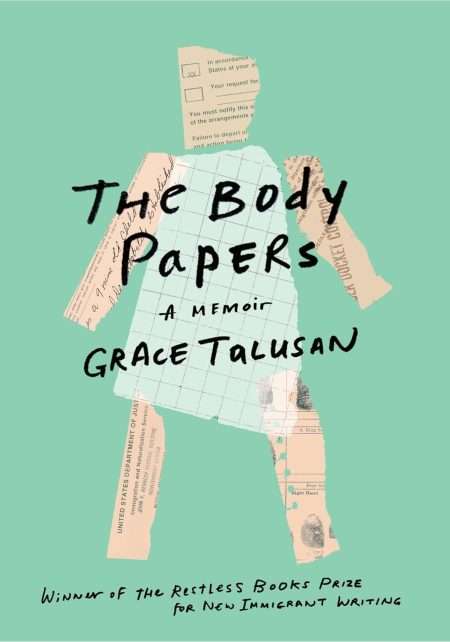
The cover of The Body Papers features fragmented immigration forms, torn and rearranged into a paper doll—a gendered girl’s body made from cheap, familiar materials. Her torso is shaped and covered by a translucent piece of gridded notebook paper. Facial features are replaced by checkboxes and official statements—bureaucratic language standing in for human identity and expressions. The paper doll stands against a bright, soft minty green background that elicits a slight sense of uneasiness. What strikes me most, though, is the quiet, strong power required to assemble these fragments in their most honest and original form. One force works to fragment, yet another, steadier attention gathers those pieces back into a person.
Grace Talusan tells her story with the same kind of resilience: a childhood shaped by migration from Manila to the United States, years spent living under the threat of deportation, and the subtle yet persistent pressures of assimilation that distorted her identity, even as she excelled academically.
The Body Papers won the Restless Books Prize for New Immigrant Writing and the Massachusetts Book Award for nonfiction, and it was selected as a New York Times Editors’ Choice. Talusan’s writing spans creative nonfiction, fiction, book reviews, and journalism and has appeared in publications such as Trace Fossils Review, Creative Nonfiction, Brevity, The New York Times, Boston Magazine, Solstice, Seventh Wave, and The Boston Globe. She is on the board of the National Book Critics Circle and teaches nonfiction writing at Brown University, where she continues to shape how others learn to tell their own stories and why doing so matters.
I interviewed Grace by email and Zoom. This profile has been edited for length and clarity.
Zihan Zhang: Much of The Body Papers explores how understanding arrives over time, often long after the body has already reacted. How do you see this gap between bodily truth and narrative truth, and how does this gap shape your process of writing the memoir?
Grace Talusan: Part of what is interesting about writing is that it’s an act of discovery for me. Think about when you recount a story and your understanding of what happened changes based on who you’re in conversation with and what they are asking you. I love that. As I deepen my understanding of the past through writing, it helps me with the present and the future. Writing is a way to be in conversation with myself.
My bodily truth is available for me and others to see and interpret. By this, I mean that people can make their assumptions about who they think I am based on how I present myself in a context. My narrative truth is more private. Most of what I write isn’t something that I will publish. But the practice of writing is always worthwhile. Publishing doesn’t have to be the end goal. Writing to understand, connect, and make sense of—these are some of the reasons I do it.
ZZ: You write about choosing to undergo preventative surgeries after discovering your family’s inherited cancer risks. You describe a moment when time collapses, and fear dissolves: “About six hours had gone in the blink of an eye. It was that easy to be and not to be.” Later, in your reflections, you imagine an alternate life, in which you were “still youthful and pretty,” your body intact, and biological motherhood still possible—before returning to the present, where love is shaped by shared responsibility and restraint. How do you see experiences of bodily extremity shaping your understanding of choice, responsibility, and what must be let go?
GT: What a fascinating question. There is so much we can and cannot control. The fact that I can lose the organs that could cause me great suffering at some point—if they develop cancer—and that I could prevent this outcome is amazing. It’s a gift. Because I saw my older relatives suffer through cancer treatments and eventually die, and because I lived through my sister’s cancer treatments, I had a great respect for the gift I was offered. Do I wait and see if I will develop cancer, or do I take the medical evidence that I have an 87% lifetime chance of developing breast cancer and do something that my other relatives were not able to do?
I was upset and angry about this genetic reality when I first learned about it. It was not fair. But I got into conversations with others going through it, and did a lot of work to stay curious and find the best path for me. Honestly, it is such a relief that I did these preventative surgeries. I don’t think about the looming threat of a cancer diagnosis in the ways that I used to. I barely think about these lost body parts at all, and that frees my energy and attention for other things in life. So I am grateful that I was able to change my life.
ZZ: When you describe returning to the Philippines as living with “the insistent ache of a phantom limb,” absence feels less like loss than like a bodily condition that won’t stop asserting itself. How do you understand immigrating, and perhaps subsequent moves, as something active and formative, rather than empty?
GT: Your question about how I understand distance “from a place as something active and formative, rather than empty,” is so interesting. I’ve never been asked this before, yet the formative experience of distance is always with me. I think this is a core question that I explore through writing—how do I understand distance? We feel closer, or more or less estranged from others and from our own selves, depending on what’s going on. The notions of leaving and returning are always in my writing. On a psychological level, perhaps because I was too young to work out what was happening when I left the Philippines and there were no conversations about it in English to me directly, I had to learn to cope with this change and then again whenever we moved homes, which was several times before we settled into the same house once I was in elementary school. Leaving, coming and going, returning, reuniting—these are human experiences that I am deeply interested in.
So many of us have this feeling, no? Whether it’s because we are students far away from home temporarily, or whether our homes have changed irrevocably through loss, there are places in space and time that we can never return to. Distance is something to pay attention to: in a relationship to people and places, in the person sitting next to you, in your own self.
ZZ: When the taxi driver in the Philippines asks why you don’t have children, you present a series of explanations that never quite satisfy, such as money, time, or illness. How did you think about that impulse to keep narrating yourself, even when you recognized the absurdity of having to justify your body and your choices to a stranger?
GT: That driver was right, in a way. None of those things matter. People have been having children under all kinds of conditions for as long as humans have existed. It’s never a good time, is it? In the moment in the car, I was irritated, but it was a question I had been asked fairly often. It really is a simple question, but in some ways, I think I was hiding from the complexity of the answer. I made my decision with my husband a long time ago—we are not primary caregivers or parents—and yet, there are times when I still long to be a parent, so I find ways to experience parenting in brief moments.
ZZ: You are an involved aunt with your nieces and nephews. You describe “aunting” as careful, anxious, and deeply invested work, shaped in part by grief for a motherhood that became impossible. How did writing about aunting allow you to explore forms of care that are intense and enduring, but often remain outside dominant narratives of family and motherhood?
GT: I have tried to write the word “aunting” several times, and it keeps getting autocorrected to “daunting.” Thank you for seeing me and what I aim to do as an aunt. My oldest niece says that I’m her second mother. She has also named me Teetah, a version of the Filipino term for aunt, tita. We need terms to express relationships beyond the dominant narratives of the American nuclear family. Did you ever see the stick-figure images on the back windows of minivans that depict a family? Sometimes there’s even a pet, a dog or cat stick figure. But how would one include an aunt or another close loved one who is involved in a caregiving role?
These relationships have always been there, but there have not necessarily been the words to name them. There are religious terms, such as godmother, and legal terms, being named in a will as a guardian of a child in the event of the willmaker’s death. I like the fact that my niece found a name organically to describe our relationship. Something kicks in when I step into a maternal role. I’ve taught college students for a long time, and it’s not the same thing. In fact, I try not to be maternal with my college students, even though I do care for them. It’s different. What I mean is that when I step into a maternal role, I try to be the best version of a mother that I can imagine. It’s hard for me to turn this instinct on for myself, to be the best version of a mother to myself, but I keep trying.
ZZ: In my own writing, I often return to the power of names and what is gained or lost through translation. In The Body Papers, you write about losing your first name, Bubut, and later rejecting it as you moved into English and American contexts, along with the intimacy of being called “Gracie” by your father. How do you think about the power and significance of names as you move between different selves, cultures, and countries?
GT: It was really scary writing those names—Bubut and Gracie—because they are so intimate and only spoken. I must be more superstitious than I like to admit because I felt so vulnerable writing them. I know that writing is a powerful thing to do, and so the fear and worry about writing my home names down in my book is related to an awareness of that power. Not that I thought something bad was going to happen to me, but those names only existed as sounds, hardly ever in writing. If one comes from a place where there has been administrative violence—and tell me where in this world some sort of violence isn’t enacted upon vulnerable people through paperwork—you probably understand why I felt anxious about writing names down.
ZZ: Some of the photographs in The Body Papers come from a family archive that predates your own memory, while others are medical or immigration documents, and still others were taken later by your husband. How did you think about selecting and placing these images alongside your memoir writing, and what role did photographs play in shaping the narrative?
GT: I had a lot of fun researching my family’s archive, and my editor helped me curate which ones to use for the book and where to place them next to the text. My husband is a photographer and always taking photos, so I think most of what I used for the book were from his existing images rather than images I asked him to make.
Your question about how photographs shaped my narrative is astute. I allowed the photographs to show me something I had not remembered or seen before. I let the photographs lead me toward meaning. Recently, for the anthology “Snapshots,” edited by Dinah Lenney, I wrote a flash essay to describe a photo of my mother. I didn’t have any preconceived notions, but I described the photo closely and trusted I would eventually discover what I wanted to say by writing about it. I allowed myself to discover whatever it was the photo wanted to tell me at that particular moment.
ZZ: You describe turning to the online yogurt-making community as a way of distracting yourself from the violence you were witnessing involving the deaths of ghost workers in Manila. How do you understand these intimate, sustaining moments functioning alongside violence, not as denial, but as a way of living next to it without being consumed by it?
GT: What an amazing question. I’ve done a lot of interviews, and your questions stand out for how thoughtful they are. Thank you. Anyone who has a phone has been living through this for years. We are aware of the specter of violence, globally and locally, in a way that was not possible before in human history. What do we do with that? What are we obligated to do? How are we moved to action?
I have to be really careful about what videos and images I view. I will read about what is happening to be informed, but I know from experience that I need guardrails on my news consumption. I won’t watch the videos. I am constantly thinking about how I can help and be of use without drowning. I am trying to attend to joy and shift my attention constantly to the good in the world because, if I don’t, I may become useless, frozen, and overwhelmed by grief. I need to believe in goodness, and I need to have hope.