
Navigating the Harsh Realities of Pregnancy in a Post-Dobbs Era: A Conversation with Irin Carmon
By Samantha Ho
Unbearable: Five Women and the Perils of Pregnancy in America
by Irin Carmon
Atria/One Signal Publishers, 2025; 320 pp; $27.96
Buy Book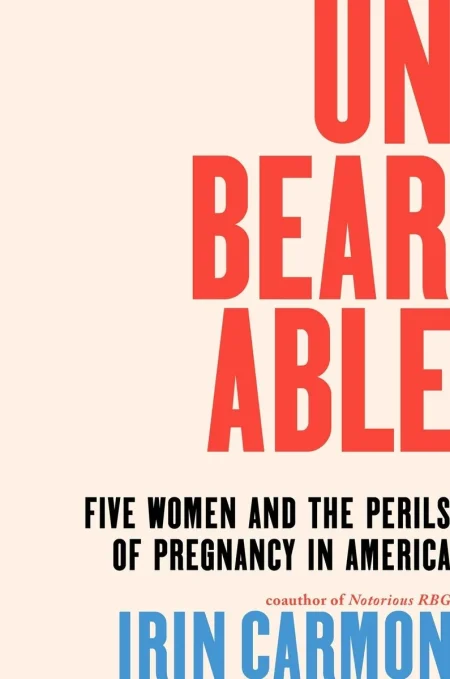
Irin Carmon was eight months pregnant with her second child when the Supreme Court allowed states to ban abortion in June of 2022, per its decision in Dobbs v. Jackson Women’s Health Organization. Angered and called to act, she wrote Unbearable: Five Women and the Perils of Pregnancy in America, informed by her own experiences and dozens of years of reporting on reproductive rights. Unbearable tracks the stories of five unforgettable women navigating the joys, losses, victories, and cruelties of pregnancy care in the United States.
Carmon explores a range of perspectives and experiences of maternity across the country, including a Brooklyn mother nearly killed by childbirth complications, a rural Alabama woman criminalized during addiction recovery, a Black New Yorker confronting racial inequities in maternal care, a lesbian lawyer denied miscarriage treatment under abortion restrictions, and a Black ob-gyn fighting to provide reproductive care in the South following the Supreme Court’s decision to overturn Roe v. Wade. Drawing from legal histories and personal anecdotes alike, Carmon unveils the fractures in the American reproductive system, and the stories it leaves untold. Above all, Unbearable is a powerful call for solidarity around reproductive rights.
Carmon is an award-winning journalist covering gender, law, politics, and more at New York Magazine. She has been a CNN contributor, a contributing writer to The Washington Post’s “Outlook,” a national reporter at MSNBC and NBC News, and a staff writer at Salon and Jezebel. She lives in New York City with her husband and two daughters. She is the author of the New York Times bestseller Notorious RBG: The Life and Times of Ruth Bader Ginsburg. Unbearable is Carmon’s second book.
SAMANTHA HO (SH): In Unbearable, you draw on your extensive background reporting on pregnancy and abortion. After covering this topic for so many years as a journalist, what motivated you to reapproach it through long-form narrative? How has your experience in journalism informed your voice as an author and your writing process?
IRIN CARMON (IC): Journalism gave me the tools to tell pieces of the story of American reproduction as it was unfolding in real time—tracking policy changes, reading court documents, and interviewing affected people and experts. But there was so much more to do and to say. Writing the book allowed me to spend three years understanding not just what happened to the five women I focus on, but who they are or were, and to better understand the forces that shaped their experiences.
SH: In confronting the political myths surrounding reproduction, how do you navigate balancing these women’s personal narratives with historical data?
IC: I knew I wanted to write about the interconnections between supposedly disparate experiences of pregnancy: abortion, birth, miscarriage, fertility treatment, and criminalization. What I didn’t know was how I’d get there on the page. The stories of these five women emerged as powerful in their own right; together, they formed a mosaic of American pregnancy experience. And each of the twists and turns of their experiences was an opportunity to go deep on the history or the policy. Why the care options are so impoverished when Maggie gets pregnant; why it’s so hard for providers, like Dr. Yashica Robinson, who want to offer better care; why abortion has been separated out from other kinds of reproductive medicine; why racist disparities like what Christine Fields experienced persist—all of these have roots in American history and policy.
SH: Reproductive justice often emphasizes how women are sidelined in their own pregnancies, as healthcare policy impedes their ability to make choices about their own bodies and families. In Unbearable, you extend this critique by showing how reproductive policy also erodes the broader care systems surrounding pregnancy—limiting access to empathetic medical care, continuity of providers, and even the presence of loved ones during birth. How did this focus deepen your understanding of what reproductive autonomy actually requires?
IC: A lot of my work has been about how these broader decisions in policy, law, and politics show up in people’s everyday lives, sometimes in ways that surprise the broader public. In Unbearable, Alison desperately wants to be pregnant but is repeatedly turned away from comprehensive miscarriage care because of Alabama’s abortion laws. Elsewhere in Alabama, Hali considers, but does not have, an abortion, and finds herself incarcerated because of testing positive for drug use during the pregnancy she kept. Dr. Yashica Robinson, barred from legally providing abortions in Alabama, wants to expand safe birthing options for her patients, only to find herself opposed by the state in ways that strikingly echo crackdowns on abortion clinics. Each of these examples illustrates how inadequate the “pro-life” and “pro-choice” language is to our realities. They tell a story of control and punishment without any notion of protecting fetal life or babies.
SH: The book repeatedly returns to the gap between what policymakers say about families and what policies actually provide for them. Was there a particular moment in your reporting when that dissonance felt especially stark or revealing?
IC: You can draw a direct line from the Alabama State Supreme Court allowing child abuse laws to be extended to embryos in service of prosecuting pregnant drug users, to the state banning abortion, to the same court finding that embryos created through IVF were “extrauterine children.” None of this—not locking up pregnant and postpartum people, not denying them the full spectrum of reproductive care even in an emergency, and not cutting off fertility treatment for people who want to build their family—could rationally be considered “pro-life.”
SH: You trace how maternal mortality review committees document patterns of preventable harm, yet struggle to translate findings into policy change. What does that gap suggest about the limits of data alone in driving reform?
IC: We already have a lot of data about how to make pregnancy safer, from more access to midwifery to decriminalizing abortion care, to name just a few examples. What we lack is political will. Worse, the very collection of that data is now endangered, both at the federal level and in states that don’t want the continuing consequences of their abortion bans to be documented.
SH: Unbearable foregrounds pregnancy as a period of heightened vulnerability that intersects with race, class, employment status, and immigration status. How did an intersectional framework shape which stories you chose to focus on and how you contextualized them?
IC: Over the years, I’ve benefited from reading and having conversations with some of the most brilliant minds in reproductive justice, law, and healthcare—people like Dorothy Roberts, Lynn Paltrow, Michele Goodwin, and Khiara Bridges. It shaped how I approached the reporting, but there’s always some measure of unpredictability in who you encounter and how the stories fit together. I couldn’t have known when I met Maggie by chance at a preschool picnic and learned her story of harm at Woodhull Hospital that two months later Christine Fields would be wheeled into the operating room with the same doctor, suffer the same botched surgery, and have an even more catastrophic outcome. It became important to understand how their stories were parallel and how they critically diverged, and that was inevitably a story of race and racism. But as I explore in the book, there are structural forces at play that go far beyond “one bad doctor” or “one bad hospital.”
SH: Throughout Unbearable, you show how maternal suffering is routinely reframed as normal or inevitable. What role does that normalization play in sustaining political inaction, and how did you work, as a writer, to make “the normal” visible as a site of harm?
IC: When, in early 2022, after the leak of the Supreme Court’s intent to overturn Roe v. Wade, I wrote news stories about the ordinary realities of what even a typical pregnancy does to the body, I was accused of fearmongering, with conservative pundits openly worrying I’d scare young women away from pregnancy. Sometimes, even what is “normal” can be profoundly destabilizing, and there’s too much silence or mystification around that. The general subtext was: shut up and have more babies. That doesn’t mean that pregnancy can’t be a positive transformation, but it’s infantilizing to tell only the gauzy part of the story. As a reporter, it’s always our job to tell the truth, even when it’s messy.
This interview has been edited for content and clarity.