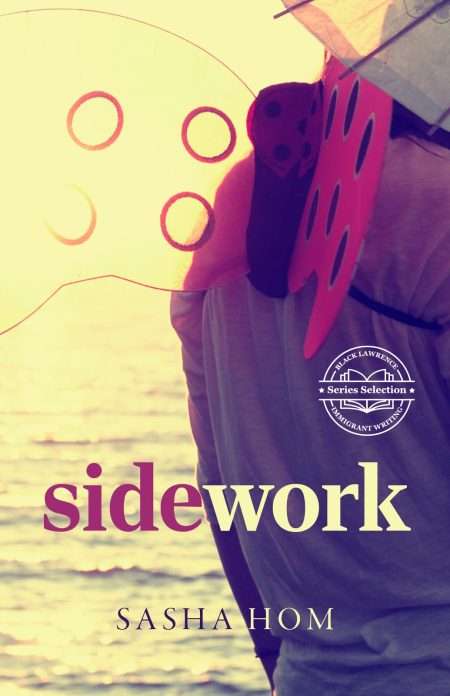
“You are loved. Goodbye.” A review of Sidework
The unnamed narrator of Sasha Hom’s novella Sidework is a waitress who lives in a van with her four children (three water births), two wolf dogs, and one husband. She’s the toughest protagonist I’ve read in a long time. “Look hun,” she says to a group of mothers eating at one of her tables, “this body has been pregnant and/or nursing for seventeen years straight.”
A fire forced the narrator’s family to leave their tent community, and then it was difficult to find a rental with an income composed almost entirely of tips. At the diner where she works, the narrator stands “by the swinging door with the coffee pot against [her] hip, which is a little sore from sleeping on the bolt in the back of the van.” While the sore narrator slings hash browns, her musician husband, who refuses to busk, is busy homeschooling the children, finding public bathrooms, and doing paperwork for food stamps.
The narrator’s work as a waitress creates the frame for the book. Sidework mirrors the fractured attention of a parent or a waitress, interspersing wide-ranging reflection and memories throughout a single morning shift at the diner. Hom uses short bursts of dialogue—sometimes funny, sometimes profound, sometimes mundane—and a whirlwind of server activity to propel the reader forward at a breakneck clip that effectively evokes the frenetic pace of a busy restaurant. In these sections we see the tearing of coloring book pages, the dropping of checks, the pouring of coffee. We meet the hair-fluffing owner; the barista with Lyme disease; the laughing prep cook, Rosanna; and the narrator’s beloved Ty, a waiter with a “bulbous butt” and “finely gelled hair,” who lays his head on her shoulder and tells her she’s a good mom.
In between these swift restaurant scenes, Sidework explores the parent-child relationship and separations within it—including death, particularly suicide—from multiple angles. The narrator of the story, like Hom, is an adoptee from Korea. She thinks of her own birth parents, reflecting that sometimes walking away is the kindest thing a parent can do. She thinks of the dishwasher at the restaurant and his children, separated by an entire country, and of the dishwasher’s mother who “keeps getting arrested trying to cross over [the US border] because she wants, so badly, to be with her sons.” The narrator thinks of her own children leaving for college: “Goodbye, we say, waving to them as they drive off in our old packed car.”
Suicide rings loud in the work. Hom’s protagonist is processing the recent suicide of a young person in her community who hanged himself. The book also includes Ty’s eventual suicide and a death reported to the narrator’s children by a woman they meet at the “community-if-you’re-wealthy” market. Each of these deaths is viewed from a distinctly maternal perspective, and so they contribute to one of the broader questions the book seems to ask: how does a mother cope with the inevitable death of a child? Of children? Of her children? There is both an urgency and a spaciousness in Hom’s treatment of these questions. She writes, “to birth is to death drawn out,” and her narrator reflects, “perhaps the greatest gift we can give our children is to teach them how to die, to rehearse it, like a fire drill . . . . Then, maybe we wouldn’t all be so afraid.”
While the material conditions and social context of the narrator’s mothering are very different from my own, I found validation, comfort, and absolution in her portrayal of motherhood. The mother in Sidework loves her children dearly. Hom writes: “Q: What is an ocean? A: It’s the feeling I have for my kids . . . . It’s something I take drop by drop and dribble into their small bodies every moment, their momma-IV . . . .” But she is also a mother who knows she is mothering in an imperfect world. I appreciated her willingness to accept the contradiction between her highest ideals and her lived experience, to ask “What kind of mother am I if I can’t give my children a hot meal?” and then to bring them a cup of cold french fries. I appreciated how she remembered letting her baby eat cherry tomatoes straight from the vine, then reflected: “You’re not supposed to let kids under the age of one—or is it eighteen months? [eat tomatoes] . . . . Too much acid . . . . Now what kind of mother does that make me?” I felt grateful for Hom’s choice to include the memory of a customer yelling at the narrator, “I saw you touching those (apparently dirty) children. You better go wash your hands.” (The narrator, addressing her child, clarifies: “But you weren’t dirty. You just came back from the fountain.”)
My favorite scene was the one in which the family is being shown a rental by a realtor. The narrator’s children race around the space, yanking at the doors, huffing the carpet, peeing in the yard. When they see the hot water heater, they scream, “Monster!” In the narrator’s retelling of this scene, I read both embarrassment and pride at her children’s wildness, their refusal to shrink themselves to fit others’ expectations. In these moments, I read a fearlessness, a kindness, a sense of possibility.
It feels as if the narrator is saying, Yes, sometimes children are dirty. It’s okay. Yes, sometimes we feed our children cold french fries. That’s okay, too. Yes, sometimes our children slam doors, or don’t learn to read until they are nine, or pee in the grass. That’s all okay, too. By creating a narrative grand enough to hold an acceptance of death, she shows the smallness of the things we often spend a great deal of time and energy worrying about. In this way, Hom puts cold french fries and dirty hands in perspective, and in this perspective, I found grace and greater spaciousness. It’s as if Hom, in Sidework, is saying, Yes, we will die. That might not be okay, but it doesn’t matter because it’s true. So maybe we don’t need to be so afraid.
1 reply on ““You are loved. Goodbye.” A review of Sidework”
Great review of a great book. Such a moving snapshot of American life in this moment. And yes the compassion to hold it all at once.