
In This Circle, You are Held: On Stephanie Duncan Smith’s Spiritual Memoir, Even After Everything
On the darkest night of the year, Stephanie Duncan Smith was grieving a pregnancy loss. It was the winter solstice and opening weekend for the new Star Wars movie. Cramping and nauseated, Duncan Smith excused herself from the crowded theater to go to the restroom. “The future was bright,” she writes, “now it was too bright to bear, and it was leaving, leaving me. Two pink lines were never meant to give way to this: the color of life, redacted.”
A week before, in a harsh and gleaming antiseptic exam room, she’d received the news that there was no heartbeat. There should have been clamor, sirens, and alarm. Instead, all was clinical; all was calm. While Duncan Smith’s loss was the first grief, the burden of pretense was the second. The world did not stop turning in the midst of Duncan Smith’s sorrow. Christmas, with its twinkling and glitter and merriment and cheer, still came. The cruel irony that she, a Christian, was to celebrate the birth of her Savior as she mourned her own expected child, is the backdrop of this memoir.
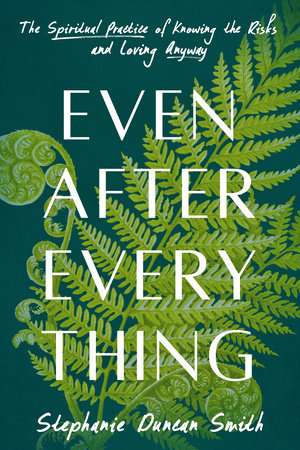
Stephanie Duncan Smith is a writer and senior editor at HarperOne. She is the mother to two healthy children, but her memoir, Even After Every Thing, was written over the course of four pregnancies. Duncan Smith’s dual timeline narrative charts her personal fertility journey (coupled with both death and life) alongside the Christian liturgical calendar: from the waiting of Advent to the joy of Easter, and then to the longest part of the year, Ordinary Time.
Because I have spent much of my life in evangelical Christian culture and have grappled with similar issues, I was drawn to Duncan Smith’s interrogation of toxic positivity. In religious spaces where a thriving life is often considered a sign of God’s favor and blessing, toxic positivity thrives. The pressure to put a shiny spin on hardship is immense. The concept of lament is foreign, replaced instead with calls to manufacture a performance of faith, to slap on a smile in the midst of sadness.
One major theme in Duncan Smith’s book is that faith and hope should not be confused with toxic positivity. To live in full color, we must be able to speak of darkness as well as light. As Duncan Smith describes it, “if you dim one set of colors in the color wheel of human experience, you will desaturate them all. And then you’d have to be over the bliss of first snows and blackberry cobbler and baby teeth.”
Advent, to Duncan Smith, felt like toxic positivity, as she was forced to celebrate birth while grieving death. She realized, though, that the Advent she was grappling with was not the full story. The light of her Savior had come, but this did not exclude the reality that the world was so very dark.
In fact, she writes that biblical and historical accounts include the grief of mothers during the Christmas season. King Herod, disturbed by the birth of the Child King, ordered the execution of all male children in Bethlehem two years and under. The slaughter is known as the Massacre of the Innocents. The lament of this loss is chronicled in the Christmas story.
Duncan Smith’s memoir of grief and hope felt important to me not just as a Christian, but as a mother who has felt the pressure to maintain a sunny disposition during dark personal trials. When my second son was born just before the pandemic, I had numerous family members diagnosed with severe illnesses. My anxiety about their health was compounded by my attempts to conceal that anxiety, to act as if all was calm, all was bright. My attempts to cover up my own experiences negatively impacted my own health and my ability to parent my new son. It was a cycle of guilt and shame fueled by the pressure to maintain a performance of cheer.
Duncan Smith’s narrative contends that our experiences of darkness do not diminish us; they are what allow us to live full, rounded lives. She writes that so much of Western culture is designed to deny the night:
When it comes to anything that cries of our mortality, our language is embarrassingly impoverished. Rather, we are told in so very many ways: Your pain does not belong here. Keep it private, we are told, far away from polite company. Stuff it down and suck it up. And get over it as quickly as possible. This is the essence of toxic positivity: the pressure to keep up the charade that all is well when nothing is okay.
But in Duncan Smith’s exploration of the Christian liturgical calendar, she finds that there is room for both joy and hardship in her religious tradition. For Duncan Smith, God’s love is not exclusively for those who pull up their own bootstraps and power through into what some might refer to as progress. Religious life is not one of perpetual ascension, she realizes as she grieves the baby she’d longed for in the dark months of the winter season. We all long for progress: moving forward, looking on the bright side, striving for self-improvement. But the world is not flat, and our lives are not linear. “Love and loss are always closer than we’d care to confess,” Duncan Smith writes. “The line between the two is thin as the rim of a coin, and, as if tossed into the air, ever shimmering.”
In Duncan Smith’s memoir, time is circular and life is layered. Women’s bodies follow cycles, and can hold both life and death. This duality—that more love means more loss—is central to Duncan Smith’s meditation. The Earth is subject to seasons, and there is a time for every season under the sun. Winter is as sacred as spring. Before there can be resurrection, there must be burial. One is not more holy than another.
For Duncan Smith, language gave her the tools to truly grapple with her layered experience: “If I could not control the darkness, I could at least name the night. I could witness it for what it was, and so give my grief the kindness of borders.” Faith and hope must look reality in its face, at the star shining in the great expanse of the night sky.
At Easter, Duncan Smith received the good news that, once more, she was expecting. And then there was the wait: the long nine months of her pregnancy stretched into what is known as Ordinary Time. Ordinary Time is the longest season in the sacred year. The liturgical calendar is often visualized on a color wheel, and this timespan appears green—months of lushness and growth. “The green season,” Duncan Smith writes, “is proving ground for all we profess to believe during the high seasons.” And so, into the banality of the everyday, Duncan Smith grew—not into certainty of a promised future, but in the knowledge that even after everything, life can be made new.